
Kitchen Design in London
Architectural Vision Meets Culinary Excellence
The heart of a London home deserves more than cabinetry and countertops. When you commission a kitchen with T&V Architects, you’re selecting an architectural practice that approaches kitchen design with the same rigor we apply to entire buildings. Our kitchens don’t simply occupy space within your home—they define it.
A Chelsea townhouse owner recently shared with us that their kitchen had become the center of her family life. Not because of grand gestures, but because every detail—from the way morning light plays across book-matched quartzite to the silent precision of concealed storage—speaks to a deeper understanding of how Londoners actually live.
That’s the difference between kitchen design and architectural kitchen design in London. We don’t follow trends. We study how light moves through Victorian windows at different times of day. We consider how a family transitions from the chaos of a school morning to the calm of an evening gathering. We design kitchens that honor both the building’s heritage and the reality of contemporary life.


Atmospheric Palettes: Beyond the Monochrome
Walk through Mayfair on a winter afternoon and you’ll understand why we approach color differently in London. The light here is particular. It shifts, it softens, it transforms. A palette that works beautifully in California can feel alien in a Primrose Hill kitchen.
We curate sophisticated color narratives that move beyond the safety of monochrome. Earthy neutrals form the foundation—warm greys that feel welcoming rather than cold, taupes that shift subtly as daylight changes. Then we introduce touches of distinctive color: a muted sage that references English gardens, a warm terracotta that brings unexpected warmth to north-facing rooms.
These aren’t decorative choices. They’re architectural decisions that respond to London’s specific light conditions. The result is a kitchen that feels calm and restorative throughout the year, not just on the three sunny days in July.

Material Integrity: Bespoke Timber Joinery
There’s a reason the finest furniture makers gravitate to certain materials. Walnut develops a patina that deepens over decades. Oak brings a sense of permanence that suits London’s architectural heritage. Ash offers a lighter touch while maintaining structural honesty.
We treat kitchen cabinetry as architectural furniture because that’s what it is. These aren’t fitted units ordered from a catalog. Each piece is custom timber joinery designed specifically for your space, your needs, your building. The wood selection happens early in our process, often before we’ve finalized dimensions, because the material itself informs the design.
A Hampstead client recently chose European oak for its straight grain and stability. The cabinetry we designed didn’t hide the wood behind paint or veneer. Instead, we celebrated it—dovetail joints visible where they add character, grain direction considered in every panel. The result brings tactile warmth to a home that might otherwise feel austere.
Technical Curation: High-Performance Systems
Professional-grade appliances have become expected in London kitchens, but integration is where most designers fail. A Gaggenau oven shouldn’t look like an imported appliance awkwardly fitted into cabinetry. It should feel like a core architectural component—because in our designs, it is.
We integrate technology as a statement of excellence. The sculptural presence of a Gaggenau range becomes a focal point. The precision of Miele dishwashers and ovens disappears into flush panels that maintain clean lines. The convenience of a Quooker tap eliminates countertop clutter while providing instant boiling water for the way modern households actually function.
This is technical curation, not technical specification. We select each system for its performance, certainly, but also for how it contributes to the kitchen’s architectural language. The appliances aren’t add-ons. They’re fundamental to the design from the first sketch.


Hidden Intelligence: Concealed Storage
A Fulham family came to us with a common London problem. Beautiful period home, elegant entertaining spaces, but every surface covered with the necessities of daily life. School bags, charging stations, breakfast items, pantry overflow—modern family life generates visual noise that period architecture was never designed to accommodate.
Our solution: hidden intelligence through concealed storage. Clutter isn’t a failure of discipline. It’s a design challenge. We design “disappearing” storage solutions that allow the kitchen to transform effortlessly from utility to entertaining mode.
Walk-in larders conceal dry goods and small appliances behind bespoke pocket doors that slide into the wall cavity. Breakfast stations with dedicated areas for coffee equipment and toasters emerge from what appear to be simple cabinet panels. Charging drawers keep technology accessible but invisible. The kitchen presents a calm, ordered face while containing everything a family needs for daily life.
This is where architectural training makes a real difference. We’re not adding storage to an existing kitchen. We’re designing rooms where storage is integral to the architecture itsel
Sculptural Ergonomics: Fluidity of Form
Sharp corners belong in commercial kitchens. In a London home, where the kitchen flows into dining and living areas, every edge matters. We use soft lines and rounded edges not as aesthetic flourish but as functional improvement to how people move through the space.
A kitchen island isn’t just a work surface. It’s a three-dimensional form that people circulate around, lean against, gather beside. By softening its edges, we create an organic transition between the kitchen and primary living areas. Children moving through the space face fewer hazards. Adults carrying dishes and glasses navigate more gracefully. The room feels more generous even when dimensions haven’t changed.
This architectural “softening” extends to handles, drawer fronts, even how cabinetry meets walls. The result is a kitchen that feels approachable rather than austere, welcoming rather than formal. It’s still architecturally rigorous—perhaps more so, because curves are harder to execute well than right angles.


Sustainable Performance: The Induction Transition
London’s journey to carbon neutrality is happening in its kitchens. We’re leading the transition to high-performance electric cooking not because it’s required, but because the technology has matured to the point where it offers genuine advantages.
Modern induction hobs deliver precise heat control that gas can’t match. They’re safer for families with young children. They eliminate combustion byproducts from your indoor air. And when integrated with discreet downdraft extraction and flush installation, they preserve the clean sightlines that define contemporary kitchen design.
We design these systems to support a fossil-fuel-free home without compromise. The cooking performance satisfies serious cooks. The aesthetic integration satisfies our architectural standards. A Westminster client recently told us they don’t miss gas at all—high praise from someone whose previous kitchen featured a professional range that required its own gas line upgrade.
Geological Artistry: Natural Stone Selection
Countertops. The word doesn’t do justice to what’s possible with rare natural stone. When you’re selecting materials that will define a kitchen for decades, you’re making geological choices with architectural consequences.
We guide clients through natural stone selection with the same care we apply to structural materials. Quartzite has become our preferred choice for its artistry and resilience. Unlike marble, which etches from lemon juice and wine, quartzite offers genuine durability. Unlike engineered quartz, it carries the variation and depth that only nature creates.
Book-matched slabs—where consecutive cuts from the same block create mirror-image patterns—become focal points that rival any artwork. We utilize precise architectural detailing in how the stone meets cabinetry, turns corners, forms splashbacks. These are permanent, high-impact design decisions. We don’t rush them.
A recent project in Holland Park features Brazilian quartzite with copper and gold veining. The slabs required three visits to the stone yard before we found matching pieces with the right balance of drama and restraint. That’s the level of curation T&V Architects brings to material selection.


Atmospheric Lighting: Layered Illumination
London kitchens need to work at 6am in December and 9pm in June. A single lighting scheme can’t serve both conditions, yet that’s what most kitchen designers provide. We design architectural lighting “scenes” that shift at the touch of a button.
Precision task lighting illuminates work surfaces without glare. Under-cabinet LED profiles eliminate shadows exactly where you’re chopping vegetables or reading recipes. Pendant fixtures over islands provide ambient warmth for evening gatherings. Toe-kick lighting adds subtle wayfinding for late-night trips to the kitchen.
Each circuit is separately controlled and dimmable. The result is illumination that’s as atmospheric as it is functional. Morning coffee happens under bright, energizing light. Evening conversation takes place in warm pools of carefully directed glow. The kitchen adapts to how you’re actually using it.
This is architectural lighting, not decorative lighting. We design the lighting in parallel with the architecture because they’re inseparable. The fixtures aren’t selected from catalogs at the end of the project. They’re integral to the design from the beginning.
Purposeful Zoning: Integrated Utilities
Ground floor planning separates adequate kitchens from exceptional ones. We specialize in the sophisticated zoning of the ground floor, treating the kitchen not as an isolated room but as part of a carefully orchestrated sequence of spaces.
Bespoke utility and boot rooms integrate into the kitchen’s architectural language. A family returning from a rainy afternoon in Regent’s Park shouldn’t drag wet coats and muddy boots through the main kitchen. We design transition zones—spaces that handle the practical realities of London life while maintaining the design coherence that makes a house feel complete.
These utility areas use the same materials, the same joinery details, the same design language as the main kitchen. The result is a cohesive transition from the city to the home. You’re not moving between different design schemes. You’re moving through a single, carefully considered architectural experience.
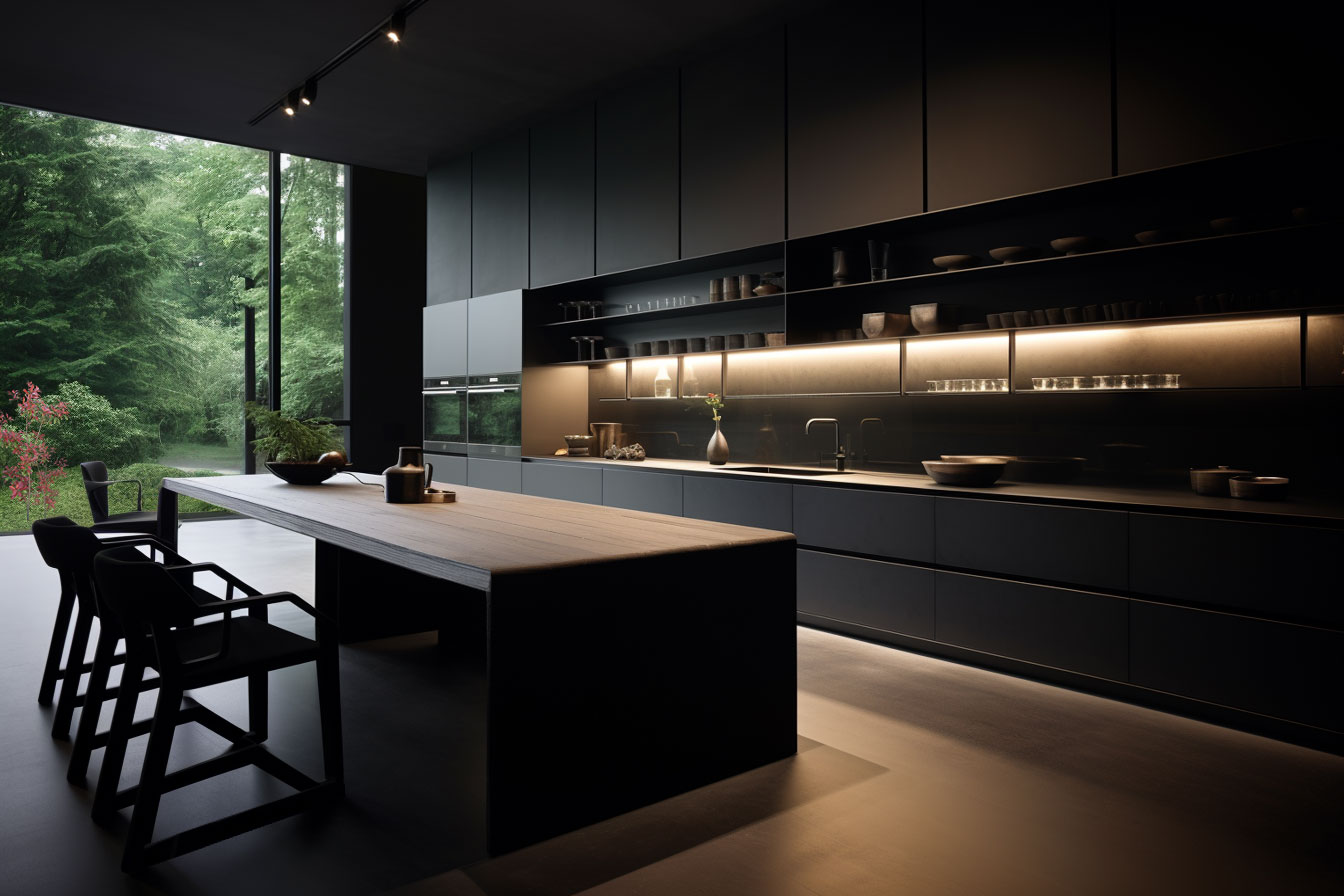

Architectural Continuity: Bridging Heritage and Modernity
Here’s what we’ve learned after designing kitchens in listed buildings, conservation areas, and period homes across London: The best modern interventions are the ones that feel like they’ve always been there.
This doesn’t mean pastiche. It doesn’t mean fake Georgian details in a contemporary kitchen. It means understanding a building’s historical narrative and designing a kitchen that feels like a natural evolution rather than a modern insertion.
In a Victorian terrace, that might mean respecting the original ceiling height and proportions while introducing clean-lined modern cabinetry. In a Georgian townhouse, it might mean aligning new joinery with existing architectural features—cornices, dados, window heights. The kitchen acknowledges where it lives.
T&V Architects brings this sensibility to every project because it’s how we approach architecture generally. We’re not kitchen specialists who dabble in design. We’re architects who apply architectural thinking to kitchens. The difference shows in how naturally the finished kitchen sits within its building.
Kitchen Design in London: The T&V Architects Approach
Whether you’re renovating a period property in Belgravia or reimagining a warehouse conversion in Shoreditch, kitchen design in London requires specific understanding of how these buildings work, how Londoners live, and how to bridge heritage with contemporary performance.
That’s the service T&V Architects provides. Not off-the-shelf solutions adapted to your space, but genuinely custom architectural design that treats your kitchen with the same rigor as the building that contains it. The result is a space that feels both timeless and entirely of this moment—exactly what the best London architecture has always achieved.